The EzyEducation website uses cookies to help ensure we give you the best experience.
If you continue without changing your settings, we assume that you are happy to receive all cookies on the EzyEducation website.
Please refer to our Privacy and Cookies Statement to

find out more.

Continue

Economic Terms

All   0-9   A B C D E F G H I J K L M N O P Q R S T U V W X Y Z

Marginal Utility

The utility received from purchasing an extra unit of a good.

Below is a table that shows how the level of marginal utility differs from total utility. It is a general feature of consumer preferences that the larger the quantity of a particular good a consumer consumes the less utility the consumer receives for each additional unit. This is because the more of a good that a consumer consumes/buys the less value they derive from it. However, as long as the marginal utility does not become negative, consuming extra units of the good will still increase the level of total utility accruing to the consumer. This is the basic property of monotonicity that all consumers have.


Market

A physical or virtual location where buyers and sellers are able to buy and sell goods and services.

Market clearing price

The price at which quantity demanded is equal to quantity supplied. There is no momentum from demand and supply imbalances for price or output to change.

Below is a diagram which shows the clearing price in both an individual goods market as well as the economy.


Market demand

The total demand for a particular good or service i.e. the sum of the individual demand of all consumers.

Below is an example of how to derive the market demand curve. At every individual price it needs to be calculated how many consumers are willing to buy a certain amount of goods. This is shown in the table below.
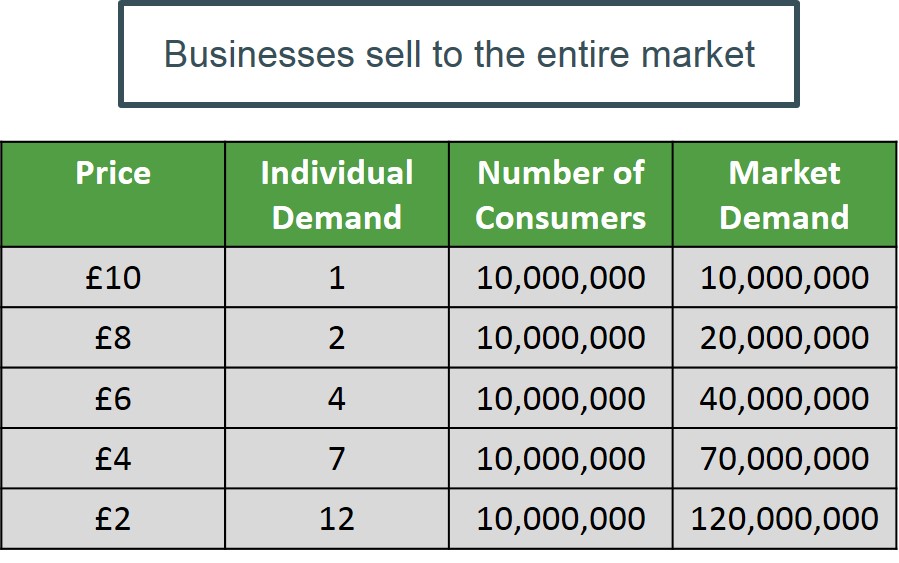
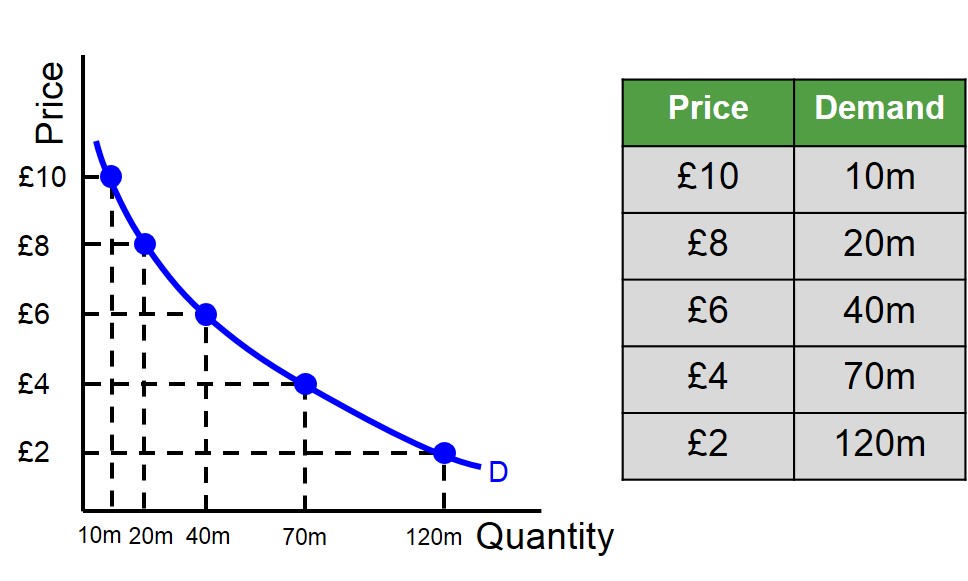
Below is the illustration of the market demand curve using the data in the table. As can be seen from the graph, the demand curve for the market has the same basic downward-sloping shape as the individual demand curve, to signify that the law of demand still holds for the market as it does for the individual demand curves.

Market economy

A system where the market forces of demand and supply determine what is produced, how it is produced and who it is produced for, without any government intervention.

Market failure

When the market fails to allocate resources efficiently i.e. the market uses too many or not enough resources to produce a particular good

Market power

When an individual supplier or consumer possess enough power to influence the market outcome.

Market power is highest amongst monopolists as they dominate the market and therefore do not have to worry about the reactions of rival firms. They prominently set a price above their marginal cost to extract as much supernormal profit from the market as possible compared to a firm in a competitive market as the diagram below shows.


Market share

The share of market output accounted for by a single supplier. It is normally expressed as a % share of the total output/revenue.


Market Size

Measurement of the total volume of a given market based on revenue.

Below is an example of how this can be calculated for a fictional market. This is done by adding up the total revenue of all the firms in the market and therefore is an indicator of the value of the business that these six firms are conducting.


Market structure

The characteristics of a market e.g. number of firms, barriers to entry and exit, the extent of product differentiation and any information imperfections.

Display # 
Forgot your password?